
.svg)

SEO vs GEO: What Google Says… and What It Doesn’t Mean
8 min read
Explore this content with AI:
Table of Contents
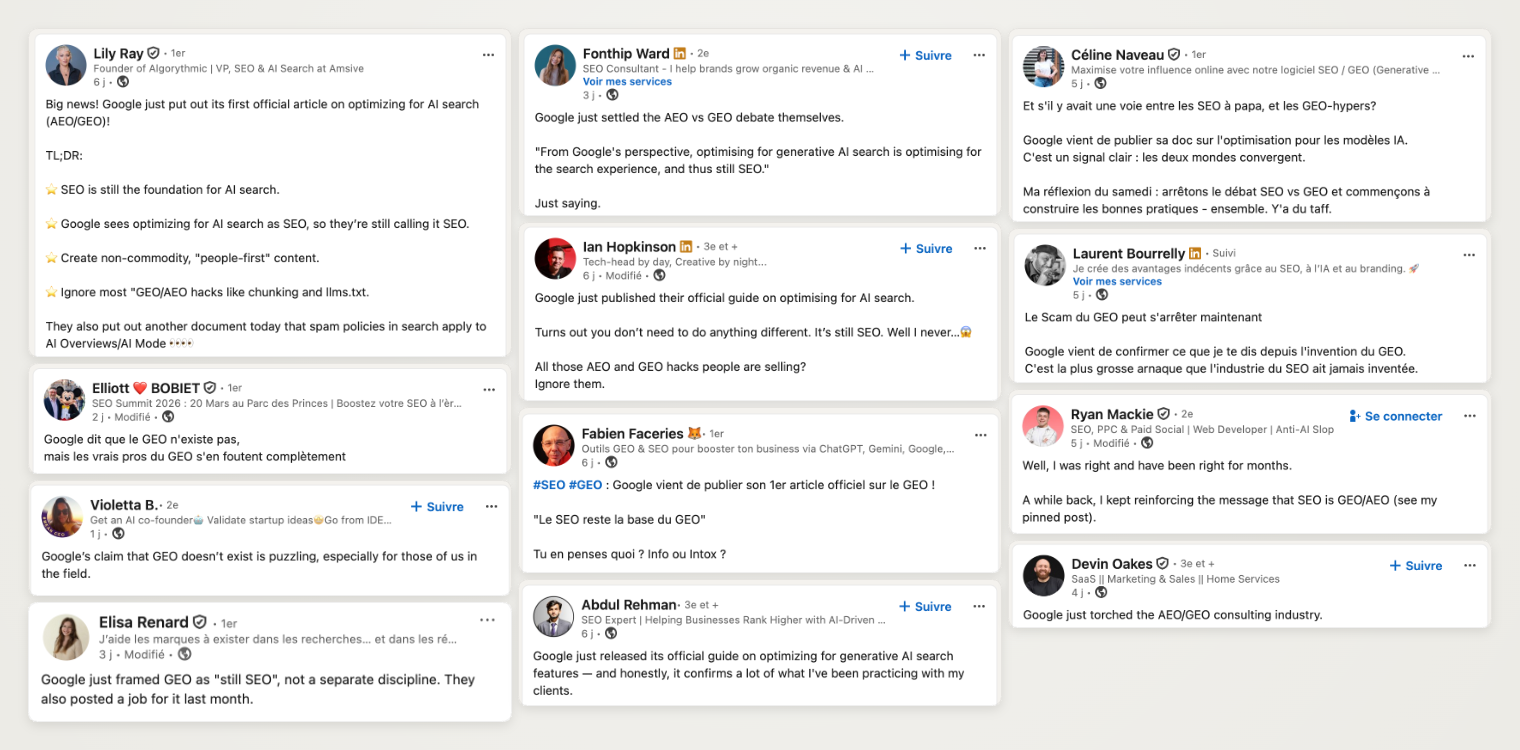
Over the past few days, Google published official documentation explaining how to optimise visibility in generative search engines like AI Overviews and AI Mode.
The main message is clear: SEO best practices remain the best practices for appearing in generative experiences. And honestly? We agree.
At Semactic, we’ve been saying this from day one: SEO and GEO are not opposites. Doing GEO without first having worked on your SEO is like building a house without foundations. Weak, poorly structured, or technically fragile content won’t magically become performant just because it targets LLMs.
The fundamentals remain essential:
- content quality,
- expertise,
- authority,
- clear architecture,
- technical performance,
- and understanding user intent.
But reducing GEO to “just classic SEO” would also mean missing a profound evolution in how people search and how search systems work. And that’s probably where the debate gets interesting.
What Google Says — and Why It’s Not Wrong
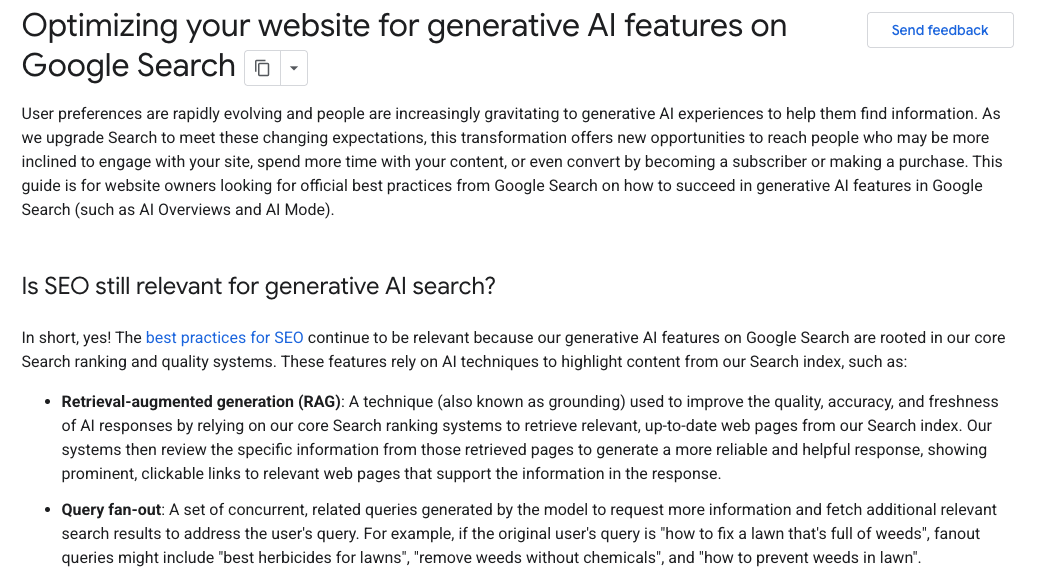
In its official documentation, Google emphasises several important points:
- create useful content first;
- prioritise user experience;
- avoid AI-specific “hacks”;
- don’t produce content artificially chunked solely for generative models;
- keep applying existing SEO fundamentals.
Again: nothing shocking here. Google is essentially reminding us that there’s no magic recipe for “optimising AI”, just as there’s no magic button for doing SEO. And that’s healthy.
The ecosystem is already filling up with dubious promises:
- “special ChatGPT optimisation”,
- “secret prompts”,
- “revolutionary GEO tags”,
- “guaranteed techniques to get cited by AI.”
Most of these approaches are closer to commercial storytelling than measurable technical reality. On this point, Google is right to call for caution.
A Very Google-Centric Documentation
Google’s documentation does, however, have its limits: it speaks primarily about the Google ecosystem. Yet today, usage is evolving rapidly:
- ChatGPT,
- Perplexity,
- Claude,
- Copilot,
- Gemini
- and tomorrow, others we can’t yet name.
Users no longer pass exclusively through a classic Google search. They ask questions directly to conversational assistants. And these systems don’t work exactly like a traditional search engine.
Even where SEO foundations remain important, the mechanisms of interpretation, selection, and delivery of information are changing. This is precisely why a specific line of thinking deserves to exist, whatever name you give it: GEO, AEO, AISEO, Generative Search Optimization, etc. The label matters little. What matters is recognising that usage is changing… and so are the systems.
The Real Shift: Visibility No Longer Guarantees the Click
This is probably the most important evolution — and the one that explains why the GEO debate goes far beyond a simple question of vocabulary.
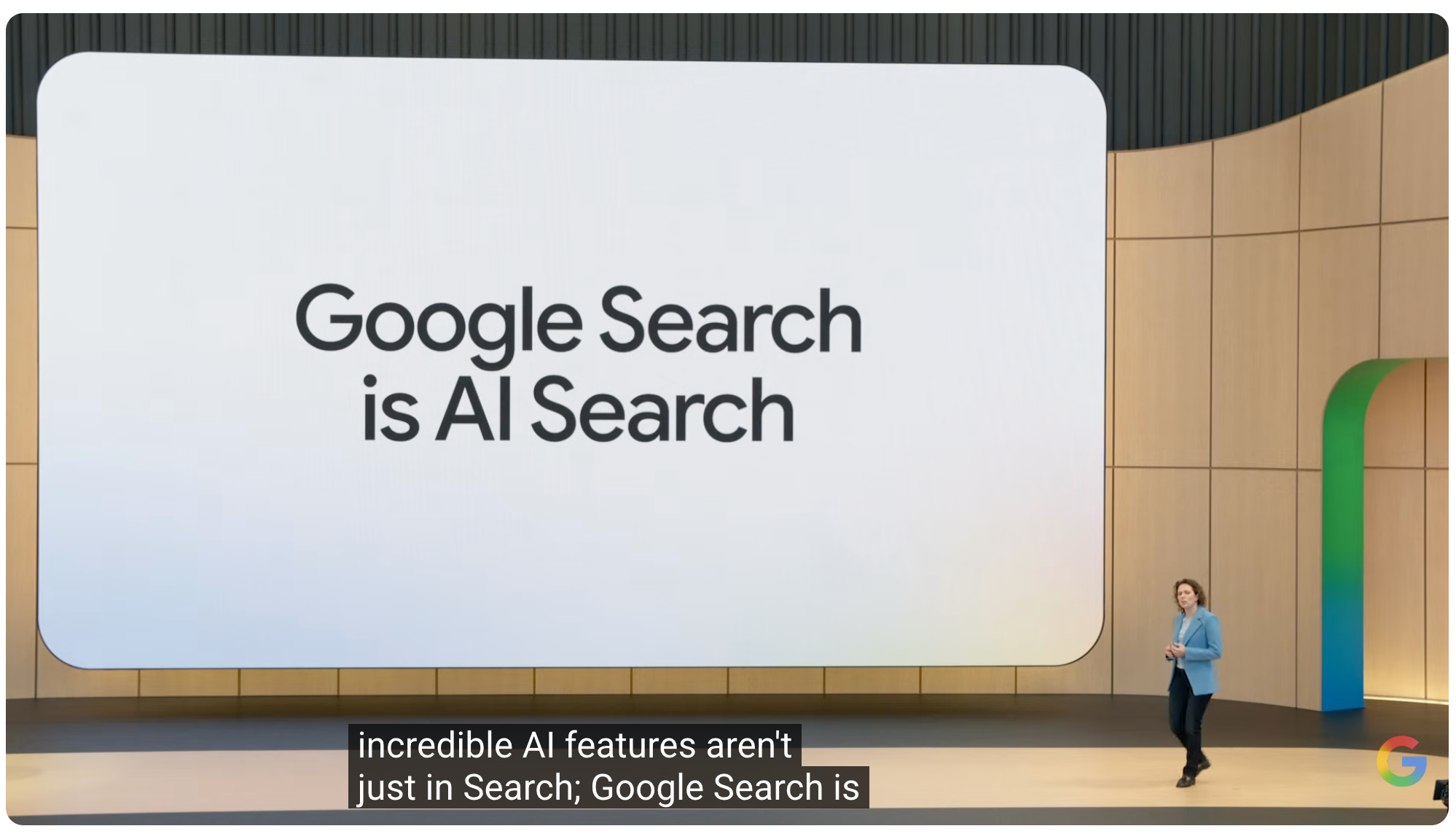
For years, SEO relied on a relatively stable logic: gain visibility in Google to generate clicks to your site. But AI Overviews are gradually changing that mechanic.
More and more often, users get
- a direct synthesis,
- a structured answer,
- a comparison,
- or a recommendation…
…without needing to click on an organic result. Even when your content contributes to generating the answer, the traffic sent to your site can decline.
And this trend isn’t limited to Google:
- ChatGPT responds without a traditional SERP;
- Perplexity synthesises before redirecting;
- Copilot also reduces the need for classic navigation.
In other words: the battle is no longer only about ranking. It now also covers
- presence in generated responses,
- citations,
- brand visibility,
- influence in conversational systems,
- and the ability to stay visible in interfaces where the click is becoming less frequent.
This is precisely why GEO thinking becomes relevant.Not because "SEO is dead." But because the mechanisms of attention distribution are evolving.
What Google Mentions Too Little (or Not at All)
1. Retrieval Mechanisms and “Chunking”
Google says there’s no need to artificially cut content into mini-blocks to “please the AI.” We fully agree with this.
But it doesn’t mean that generative models don’t segment content themselves. On the contrary. Most modern retrieval systems work via
- embeddings,
- passages (“chunks”),
- and contextual retrieval before generation.
The real implication is:
- state your ideas clearly,
- create semantically self-contained sections,
- avoid vague or diluted content,
- and structure information in a way that’s easy to interpret.
A 1,500-word block with no clear hierarchy and elaborated figures of speech may be perfectly readable for a motivated human… while being difficult for some AI systems to extract value from.
2. Query Fan-Outs and Intent Fragmentation
Many AI assistants don’t answer a query with a single search. They generate multiple sub-queries:
- reformulations, c
- omplementary angles,
- cross-validations,
- additional source searches.
This reinforces the importance of
- semantic coverage,
- complementary content,
- explicit phrasings,
- clarity of answers,
- and expertise signals.
3. Citation Is Becoming a Standalone Challenge
In classic SEO, being visible mainly means appearing in results. In generative engines, a new challenge emerges: being picked up, cited, reformulated, or used in the generation of a response.
- Why are some brands cited more often?
- Why do some content pieces become conversational references?
- Why are some pages used to generate answers even when they’re not top-ranked on Google?
We’re still at the beginning of understanding these mechanisms. But ignoring their existence would likely be a strategic mistake.
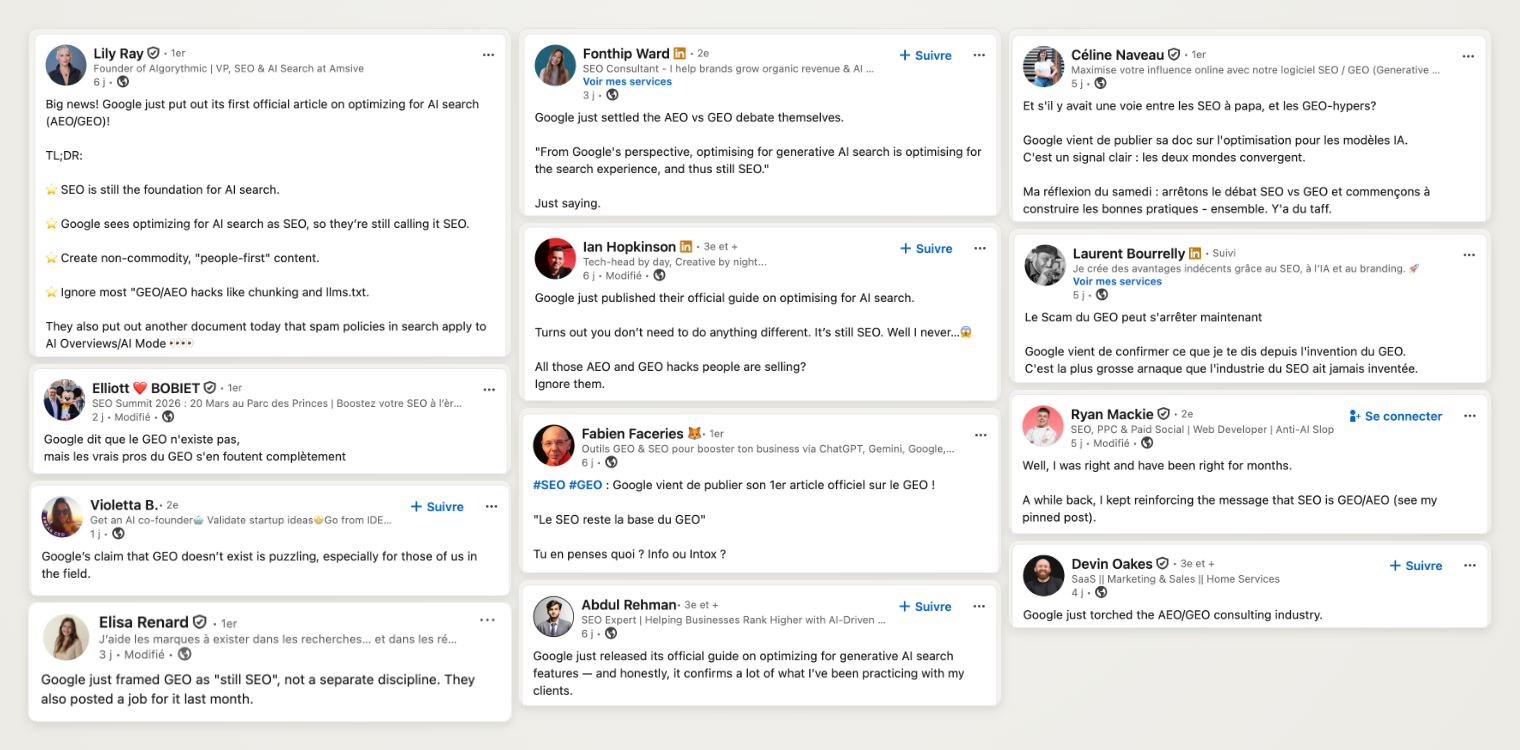
What the Ecosystem Thinks
Some “Hacks” Are Worth Testing
We also need to stay clear-eyed: Google naturally communicates what serves its own interests and its own vision of the ecosystem. Historically, SEO has already seen several examples where Google’s public statements didn’t tell the whole story.
For a long time, Google claimed that user clicks didn’t directly influence ranking… until internal documents from the US antitrust trial revealed the existence of the NavBoost algorithm. This doesn’t mean you should believe every SEO/GEO hack that circulates. But it does mean maintaining a pragmatic approach: test, measure, observe, separate real signals from noise.
So… Why Talk About GEO at All?
That’s probably the real question. And it’s a legitimate one.
If GEO is built on SEO fundamentals, why give it a specific name?
Because usage is changing.
Because interfaces are changing.
Because systems are changing.
Because search behaviour is changing.
SEO remains the indispensable foundation, but generative engines introduce
- new user journeys,
- new discovery mechanisms,
- new visibility logics,
- new citation challenges,
- and new ways of interpreting content.
Ignoring this evolution would mean assuming that AI Overviews, ChatGPT, or Perplexity change nothing about search. But they already change a great deal.
The Right Strategy: SEO and GEO, Together
For us, the question has never been: “should SEO be replaced by GEO?”
The real question is: how do you protect what generates visibility today, while preparing for the usage patterns that will dominate tomorrow?
Your strategy must allow you to
- keep performing on Google Search,
- stay visible in generative experiences,
- strengthen your brand authority,
- make your content usable by AI systems…
…all without sacrificing the SEO fundamentals that continue to drive business.
This is exactly the approach we defend at Semactic. Not a SEO vs GEO opposition. But an integrated SEO + GEO strategy, designed for the current reality of search.



Built by SEO experts, Semactic turns AI Search and SEO / GEO visibility into a clear, guided workflow : see where you stand, prioritize what matters, take action, and measure the impact.


