EN
AI Overviews are coming to France. Google confirmed it in a letter sent to French press publishers on June 29, 2026: the feature will roll out before September 23, 2026, alongside the conversational AI Mode. After two years of regulatory deadlock over neighbouring rights, the countdown has started.
What makes this rollout unusual is that a francophone reference market already exists. French-speaking Belgium shares the same language, similar search habits, and a comparable digital ecosystem with France. At Semactic, we've been tracking AI Overviews across our Belgian portfolio for several months, and the data gives us an unusually precise picture of what French SEO teams can expect.
This study draws on the semantic tracking of over 30 active clients in French-speaking Belgium, across a wide range of sectors: social protection, insurance, energy, Tech/SaaS, non-profit, healthcare, tourism, and e-commerce. More than 20,000 keywords were analysed between June and July 2026, using SERP data extracted from our platform.
The lens here is structural. Whether an AI Overview triggers depends primarily on the nature of the query and the sector, not on a site's authority. One methodological note worth keeping in mind: larger keyword portfolios naturally cover more informational queries, where AI Overviews fire most often. Cross-sector comparisons need to account for that.
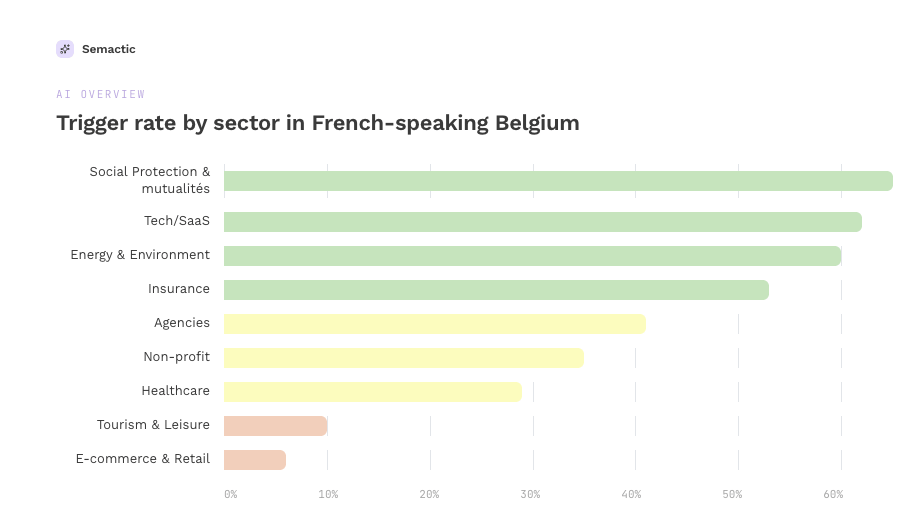
Sectors producing informational content for professional audiences show the highest trigger rates in our dataset, close to 80%. Queries like "how does X work", "what is Y", or "difference between A and B" are precisely the kind Google wants to synthesise. For digital marketing, SaaS, and consulting players in France, this is exactly the content Google prioritises.
Social protection players show trigger rates between 70 and 75%. Queries around social rights, healthcare reimbursement, employer obligations, or public support schemes are exactly the ones where Google feels a responsibility to provide a clear, synthesised answer. For mutualités, joint bodies, and social protection organisations in France, AI Overviews will be present from the very first weeks on a very significant share of their strategic keywords.
Energy transition sectors show trigger rates consistently above 75%. Questions about heat pumps, renovation grants, or industrial decarbonisation solutions systematically generate AI Overviews. The notable pattern here is that triggering is near-universal on informational queries, but brand presence within those summaries remains limited. That's a concrete opportunity for players who position themselves before the French rollout.
Insurance brokers sit around 53%, with a highly informational query profile around products, comparisons, and legal obligations. General non-profit organisations show rates around 35% on broad topics (charitable giving, social rights, volunteering), but much lower on highly local or institutional keywords. Tech/SaaS and agency players range between 40 and 62% depending on their keyword mix. Editorial competition in these spaces remains low, which makes the opportunity particularly attractive for those who move now.
At the other end of the spectrum, transaction-heavy sectors such as e-commerce, retail, tourism, and food show trigger rates typically below 5 to 10%. Purchase-intent queries are not what Google is trying to synthesise.
One nuance worth noting: US data shows Google is progressively extending AI Overviews to comparative queries, with trigger rates reaching up to 95% on that query type. The landscape can shift quickly.
The evidence points in the same direction across studies. According to Ahrefs, the presence of an AI Overview reduces the average click-through rate of the top organic position by 58%. Pew Research Center found that only 8% of users click on a result when an AI summary is present, versus 15% without one, and 26% end their browsing session entirely.
The more encouraging news comes from Seer Interactive, which found that organic CTR on AI Overview queries rebounded 85% between December 2025 and February 2026, after 18 months of decline. The drop has stabilised. The structural gap versus queries without an AI Overview remains around 37%, though.
The real implication is that brands cited within summaries significantly outperform those that aren't, with up to 35% more organic clicks on the US market for cited sites. The goal is no longer just to rank well. It's to be selected as a source.
Understanding what proportion of your keywords already trigger AI Overviews in the francophone markets that are already live is the starting point. Without that baseline, preparation stays theoretical
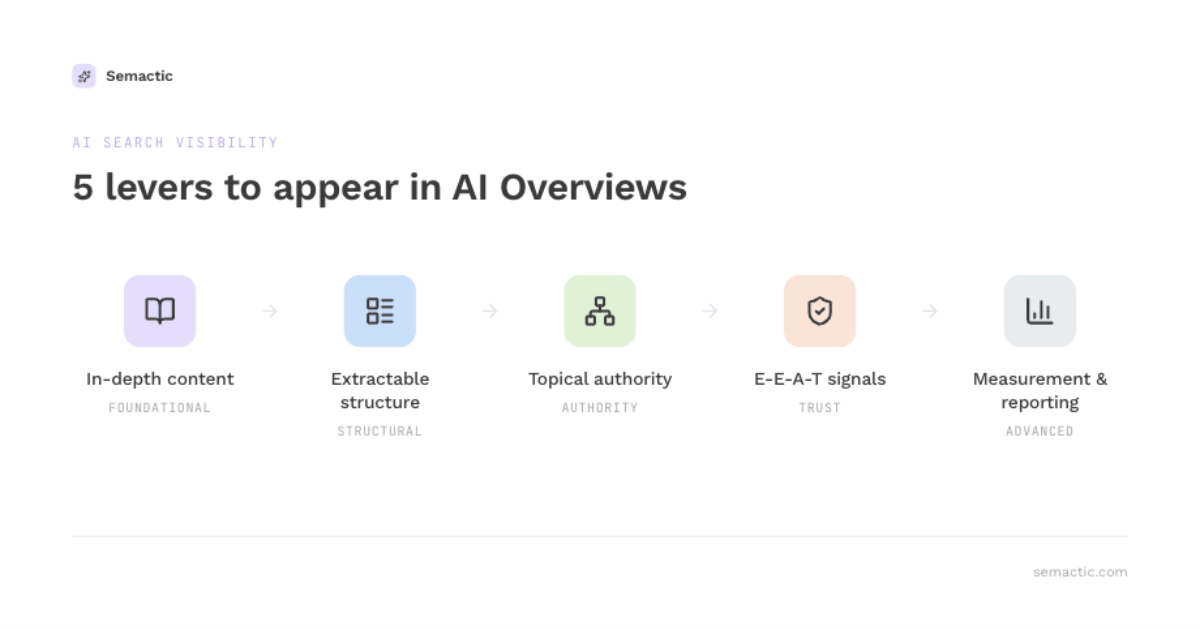
AI Overviews will fire almost exclusively on informational queries. The goal is to produce content Google can synthesise: in-depth articles, practical guides, detailed FAQs, "what is" and "how to" content, sector-specific comparisons.
Google pulls precise passages to build its AI summaries. A few simple rules:
Having one strong article on a topic isn't enough. Google assesses a domain's overall authority on a subject. The topic cluster approach (a pillar piece supported by a web of interconnected satellite content) is more relevant than ever in this context.
Google relies on Experience, Expertise, Authority, and Trustworthiness signals to decide which sources to cite. Showcasing authors, sourcing content explicitly, earning mentions from recognised third parties... all of this factors into selection. At the same time, positions and organic CTR are no longer enough to measure real visibility. AI Overviews need to become a KPI in their own right. Google Search Console has already started integrating AI responses into its metrics.
The arrival of AI Overviews in France in September 2026 is no longer a hypothesis. Belgian data lets us map the terrain with a precision that US studies couldn't offer: same language, same triggering logic, same sector hierarchy.
AI Overviews won't affect all sites the same way. But for players positioned on informational queries in sectors like social protection, insurance, energy, or Tech/SaaS, the impact will be immediate and preparation doesn't happen in a few weeks.
The time to act is now.
Seer Interactive, cited in Dataslayer, Google AI Overviews: The End of Traditional CTR (April 2026). dataslayer.ai
Ahrefs, Update: AI Overviews Reduce Clicks by 58% (December 2025, 300,000 keywords, aggregated GSC data). The same study shows that in 2026, 62% of AI Overview citations come from pages outside the organic top 10. ahrefs.com
Pew Research Center, Google Users Are Less Likely to Click on Links When an AI Summary Appears in the Results (July 22, 2025, 900 US adults, 68,879 real searches in March 2025). pewresearch.org
Seer Interactive, AIO Impact on Google CTR: 2026 Update (April 2026, 53 brands, 5.47 million queries, 2.43 billion impressions, January 2025 – February 2026). seerinteractive.com




.svg)