EN

Optimizing product feeds is not a new topic. In e-commerce, teams have long been working on the quality of product titles, categories, attributes, images, prices, availability, and descriptions.
Much of the advice we see today regarding e-commerce therefore already existed before the advent of AI engines. What has changed, then, is not the importance of the data itself, but rather the way this data flows before being integrated into a generated response.
In a traditional search environment, we can still relatively clearly distinguish the main areas for optimization: organic pages, Shopping results, ads, marketplaces, and so on.
In a generative environment, these boundaries become less distinct. An AI response may draw on a category page, a product listing, a third-party source, a product feed, a marketplace, or a combination of several of these elements.
It is precisely for this reason that the statement “you need to optimize your product feed for GEO” strikes me as both accurate and insufficient. It is accurate because product feeds remain a key driver in the flow of e-commerce data. But it is insufficient because it sometimes assumes too direct a relationship between the feed and the resulting response.
However, in many cases, it is unclear whether the AI engine reads the feed directly, retrieves a Shopping listing influenced by that feed, relies on a product page, combines multiple results from a SERP, or uses a platform-specific product ingestion mechanism.
The methodological challenge, therefore, is to reframe the question: it is not merely a matter of asking how to optimize the feed, but first of all to understand what data is actually retrieved, from which surfaces, with what level of accuracy, and in what form.
There is currently a strong temptation to take best practices from e-commerce SEO or feed management and repurpose them as GEO recommendations. More descriptive titles, complete attributes, and so on. All of this remains important, but these are already well-known fundamentals. Their value does not disappear with AI engines -quite the contrary. But their strategic value now depends on their actual role in the data retrieval and selection process.
The issue, therefore, is not whether a product feed must be clean - it must be. The real issue is determining which part of this data is actually observable by the layers that AI engines use to construct their responses.
In a generative environment, these inconsistencies can become critical, as retrieval systems may access different versions of the same product data.
This is where the topic becomes more interesting than simply optimizing the feed. The product feed is just one layer among many in a broader architecture. It’s not about treating each of these layers separately, but about understanding how they interact, reinforce each other, or contradict one another.
When analyzing e-commerce visibility in AI search engines, it may be helpful to distinguish between source visibility and product visibility. In SEO, we typically examine the visibility of a domain, a URL, or a set of pages for specific search queries. In GEO, this approach remains necessary, but it is no longer sufficient. A brand may be used as a source in a generated response without its products being included as specific recommendations.
Conversely, a product may be mentioned or displayed in a response without the brand’s category page playing a visible role in justifying that response.
Source visibility answers an initial question: Are the website, category page, guide page, or product page used as references by the AI engine? This layer remains closely aligned with SEO logic: page quality, semantic relevance, authority, indexability, content structure, internal linking, crawl depth, accessibility of information in the HTML, and the page’s ability to address a search intent.
A well-structured category page can therefore help a brand be identified as a relevant source for a generic search query - whether it’s for children’s shoes, an ergonomic mattress, or a cordless vacuum cleaner.
Product visibility addresses a different question: Are this brand’s products listed as concrete options in the search result? At this level, the analysis focuses not only on the relevance of a page, but also on a product’s ability to be understood as a relevant and recommendable option.
This layer relates less to traditional documentary logic than to product selection logic. The product must not only be present on the web; its information must be clear and actionable enough for it to be included in a recommendation.
For an e-commerce merchant, the assessment cannot therefore be limited to a binary reading: “the brand appears” or “the brand does not appear.” Instead, it is necessary to analyze at what level it appears: as a source, as a recommended product, or as a transactional entity.
This distinction becomes particularly interesting when we observe that certain queries do not serve the same purpose. Some search results may target reference pages, while others may target specific products to display. In an e-commerce context, it is not just the rephrasing that matters, but the function of the query within the final response.
A brand may rank well for search queries used to find sources - particularly through its category pages - but be much less visible for queries used to identify products. The latter are often more descriptive, more usage-oriented, or more closely aligned with a shopping-oriented approach.
Several observations shared within the community show that by examining certain network requests or interface behaviors, it is sometimes possible to identify clues about the sources used to construct a response. Certain fields, such as `result_source`, have been discussed because they appear to indicate different channels for retrieving or sourcing information.
Values such as “serp,” “bing,” “bright,” or other systems suggest that the generated response may be preceded by a structured retrieval phase: a query is reformulated, sent to a source, results are retrieved, and then certain elements are selected to populate the final response.
These observations, however, must be treated with caution. A field visible in a network request is not official documentation. It provides a clue, not comprehensive proof of internal operations. The risk would be to turn a technical signal into strategic certainty, whereas these systems evolve rapidly and may vary depending on accounts, countries, queries, interfaces, or types of intent.
From this point on, the approach focuses less on replicating the engine’s internal workings and more on identifying relevant areas for comparison. If certain products are recommended in a generative response, it becomes interesting to observe whether they also appear in other visible environments related to the same query, in order to better understand the overlaps, discrepancies, and data that may be taken into account.
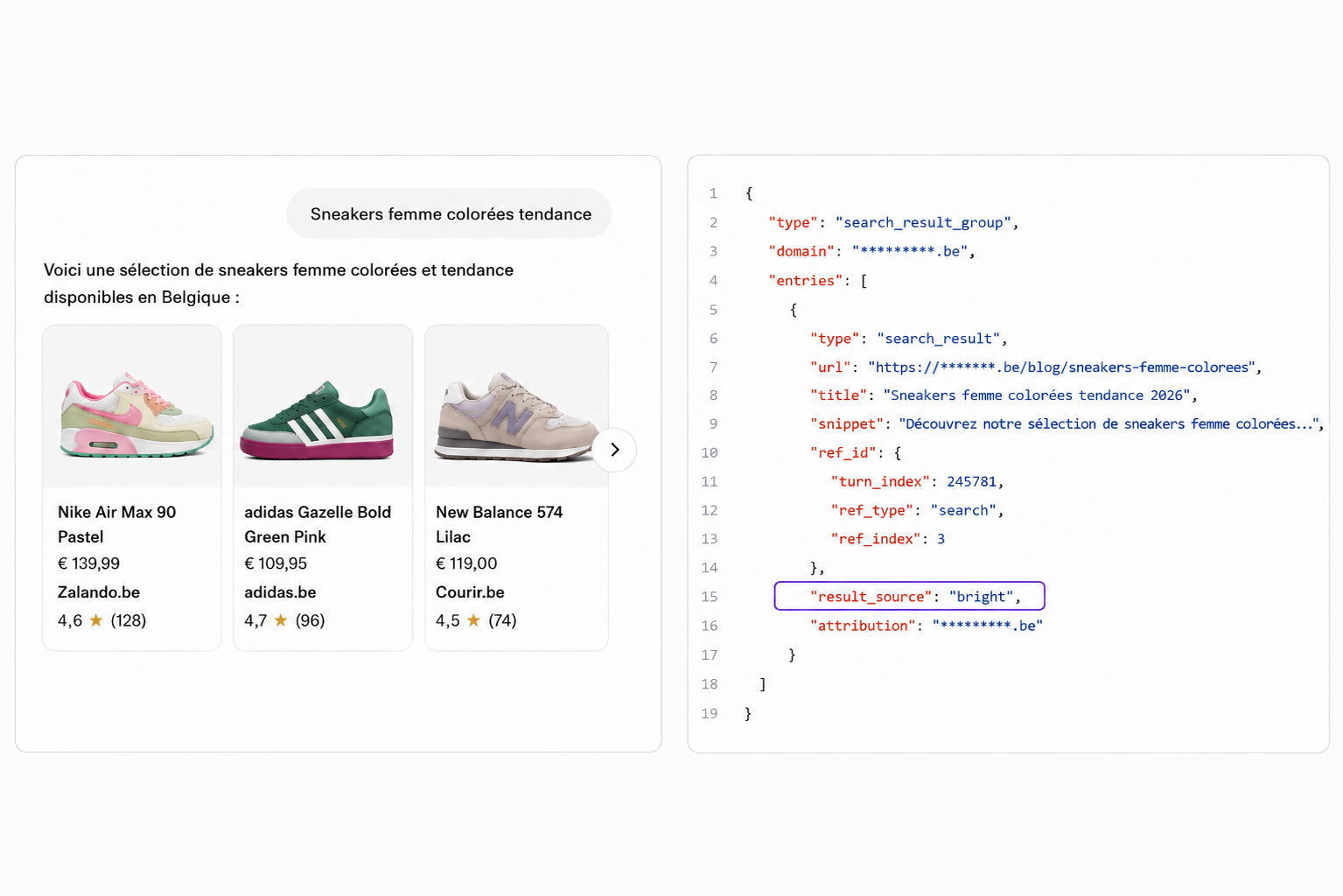
The product feed is one of the layers to be considered in this data retrieval chain, but its role should not be assumed too quickly. Depending on the platforms, configurations, and surfaces observed, it can play a role in different ways: as a direct source when the merchant transmits its product data to a platform via a dedicated ingestion mechanism, or more indirectly when it feeds Shopping surfaces, free listings, or other environments, which are then retrieved or reinterpreted by third-party systems.
This distinction is important to avoid confusing indirect influence with direct use of the feed. Saying that “the product feed influences AI visibility” is likely reasonable in many cases. Saying that “AI directly uses the Google Merchant Center feed” is much less reliable without solid evidence.
In certain contexts - particularly with the emergence of product feed mechanisms specific to AI platforms - the relationship may become more direct. In others, the feed primarily acts upstream, improving the quality and consistency of product information visible within the search ecosystem.
The product feed should therefore be viewed as a layer of influence, not as an isolated source. It can be used directly in certain environments, or it can act indirectly by populating shopping sections, free listings, product listings, structured data, or other environments that are then retrieved by third-party systems.
Before expanding or enriching a feed, it is therefore essential to understand where the product data is actually visible, in what form it circulates, and where discrepancies arise.
One of the main risks in GEO is producing generic recommendations under the guise of novelty. While it’s true that clear titles, complete attributes, and up-to-date prices are necessary, that alone isn’t enough to produce a distinctive analysis. Marketing and e-commerce teams are already aware of these recommendations. The added value of GEO should instead lie in identifying which elements truly seem to differentiate the products indexed by AI engines from those that are not.
This is where a differential approach becomes valuable. Rather than analyzing only the recommended products, they should be compared with other products visible in response to the same query: those appearing in Shopping results, in organic results, on the brand’s category pages, or in equivalent competitor offers.
This type of comparison helps avoid jumping to conclusions too quickly. If all recommended products have visible reviews, this isn’t necessarily proof that reviews are a selection factor. But if, for a comparable search query, the products that aren’t featured consistently have fewer visible reviews, less descriptive titles, or less prominently displayed attributes, we begin to identify actionable signals.
The goal is not to immediately arrive at a perfect causal model. That would be unrealistic. Rather, the aim is to reduce uncertainty by identifying recurring differences between products that are included and those that are not. From there, the recommendations become more precise.
We will no longer simply say, “Enrich your product titles,” but rather: “Products included in this query cluster almost always contain the product’s use, brand, and type in the first visible elements of the title, whereas your internal titles begin with a reference or collection that isn’t very descriptive.”
It is this precision that distinguishes a credible GEO recommendation from a generic one.
To test this hypothesis, we must accept a significant methodological limitation: we cannot exactly replicate what an AI engine sees. Systems change, responses vary, sources are not always disclosed, queries may be rephrased, and the data used may depend on the context, the interface, or the type of intent.
One possible method is to start with a set of representative queries, ideally grouped by intent. We should not only test generic queries but also comparative, transactional, or need-oriented queries. The goal is not to conduct an exhaustive test but to observe whether certain types of queries highlight products, brands, or attributes more frequently.
For each query, several layers of data should be compared: the AI response, any sources cited, the products mentioned or displayed, the visible category pages, the associated product detail pages (PDPs), the information in the product feed, and the data actually displayed on the site. The goal is not merely to verify whether a product appears in the same location across multiple sections, but to understand whether the information describing it is consistent, visible, and actionable across these layers.
The analysis should therefore not be limited to simply matching an AI response to a given product area. Above all, we must look for discrepancies: Is a product recommended by the AI described accurately in the feed but difficult to read on the PDP? Is a brand cited as a source without its products being included? Do competing products highlight certain attributes more effectively on their pages or in their product data?
The most interesting part, then, is comparing the attributes available in each layer. If a product appears in an AI response, we must examine the form in which it appears and where the information used seems to be available. Does the title used correspond more closely to the feed title, the product page title, or a rephrased version? Are the highlighted attributes present in the feed, visible on the product detail page (PDP), or included in the structured data? This analysis allows us to gradually trace the potential data retrieval chain, without claiming to prove it entirely.
A useful output, therefore, would not simply be a table showing presence or absence. Rather, it would be a comparison matrix cross-referencing queries, brands, products, store locations, and attributes. Based on this matrix, we could generate a few simple metrics: source visibility, product visibility, consistency between feed and product detail pages (PDPs), attribute readability, data alignment, and discrepancies across platforms. These metrics do not replace qualitative analysis, but they help structure the audit and compare multiple brands, categories, or test periods.
A product may be well described in one layer but less clear in another. It is precisely this flow of product data between different platforms that must be understood before formulating optimization recommendations.
The product feed remains an important lever, but it should not be analyzed in isolation. In a generative environment, the question is not only whether the product data is complete, but also understanding where it is visible, in what form it can be retrieved, and how it interfaces with other surfaces.
Before enriching a data feed or modifying product fields, it is therefore essential to examine the data’s journey. This step enables the transition from a generic recommendation to a more targeted optimization, based on what AI engines actually seem capable of retrieving, comparing, and leveraging.
In e-commerce, the challenge is therefore not to optimize further simply for the sake of it. The challenge is to identify which version of the product data actually flows to the retrieval layers used by AI engines, and then to take action where discrepancies are most evident.
In other words: before prescribing optimization, you must understand the retrieval process.




.svg)