EN

Being a market leader doesn't guarantee you exist in AI responses. That's one of the key findings from this new edition of the Trends AI Brand Index, produced by Semactic in partnership with Trends-Tendances. Across three Belgian sectors (real estate, energy and telecommunications) data from ChatGPT and Google AI Mode show that AI visibility doesn't always mirror market hierarchies. Century 21, Belgium's leading real estate network, is absent from responses to local search queries. DATS 24, ranked 7th overall in the energy sector, dominates questions about customer service. MS-Immo, an agency with no national profile, outranks every major network on the question of lowest commission rates. What these gaps share: it's not budget or brand size that drives AI visibility, it's the relevance of what you publish, and where you publish it.
One distinction is essential to reading this data: ChatGPT draws from its training corpus: press, Wikipedia, price comparison sites, forums. AI Mode performs a live Google search for every query using a "query fan-out" technique that can trigger hundreds of parallel searches, and systematically cites its sources. Same question, same language, often two completely different winners.
The overall ranking puts Century 21 first, ERA second, Engel & Völkers third. But share of voice is collapsing for everyone. The "Other" category (players outside the top 10) now captures 76% of mentions, up from 56% in March. AI visibility in Belgian real estate is fragmenting rapidly: LLMs are citing a growing number of different actors, reducing concentration on the large national brands.
The paradox: Century 21 has a blog, Facebook pages, and Google My Business listings for each franchise. But on local queries ("best agency in Brussels", "best agency in Charleroi"), their franchises don't surface at the top of Google Maps results. Against independent local agencies showing 4.9/5 with 400 reviews, the average GMB scores of franchise locations don't hold up. Century 21 leads globally. but on the strength of a reputation built outside its own digital channels, not through live search performance.
On AI Mode, responses to local queries draw almost exclusively from Google My Business: "best agency in Brussels?" → Sky Realty (4.9/5), Vaneau Lecobel, By the Way. "Which agency knows the Charleroi market?" → Club Immobilier, Cap Sud, La Confiance Immobilière. Century 21 and ERA absent in both cases. The selection criterion is clear: the highest Google rating, combined with the highest volume of recent reviews.
GEO's meritocratic logic shows through clearly on specialised questions. MS-Immo dominates ChatGPT's response to "which agency charges the lowest commission?", because its website clearly states "1% excl. VAT". TRIOR appears on "best value for money" because it publishes a verifiable success rate. Les Viviers ranks on "building plot" thanks to a URL whose structure matches the query exactly. The logic is consistent: if you are the most relevant source for a precise question, you become the answer, regardless of your size or budget.

The corpus data also shows that Facebook and YouTube appear among the sources AI Mode consults on certain questions, alongside websites and GMB listings. We Invest surfaces on the question "which agency for selling in Brabant wallon?" via a video from its local branch WeInvest.BWCentre, cited directly by AI Mode as a source. It's not the dominant signal in the corpus, but it illustrates that content published on these platforms can, in some cases, feed into LLM responses.
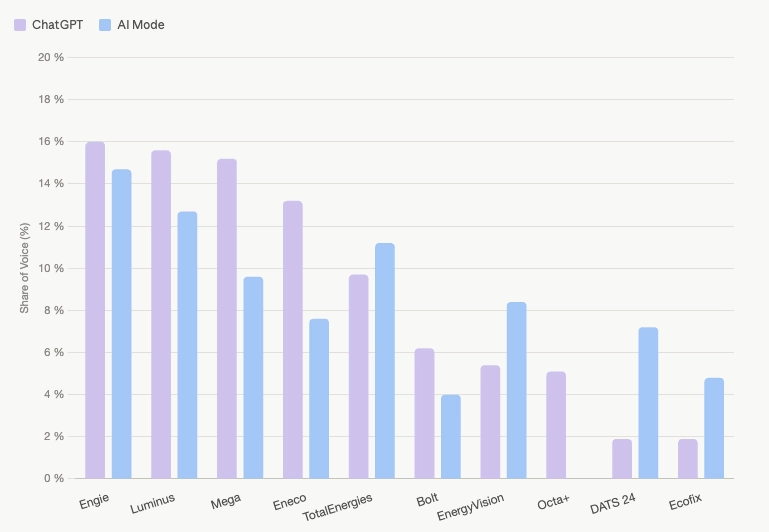
The overall podium puts Engie first, followed by Luminus and Mega. But the most structural finding lies elsewhere: in the energy sector, providers don't directly control their GEO visibility. Price comparison platforms do it for them. Selectra SAS operates under three brands in Belgium, callmepower.be, selectra.be, mon-energie-verte.be, with a total grip on tariff-related questions. A single CallMePower URL is cited across 42 of the 50 market questions by AI Mode.
Each type of query activates a distinct source ecosystem, and different winners. On price questions, EnergyVision and Ecofix outrank Engie and Luminus because comparison platforms put them at the top. On customer service, DATS 24 captures 73% of share of voice on that specific driver, thanks to a single annual Test-Achats survey. On green energy, the Greenpeace ranking sets the standard: Cociter tops ChatGPT because Greenpeace gives it a perfect score. On digital topics, Luminus leads thanks to favourable Reddit r/belgium discussions about its app.
On the Belgian French-speaking telecoms market, the overall ranking is stable: Proximus leads, followed by Orange, Telenet and Scarlet. But behind these positions, very different dynamics play out depending on the type of question, and the LLM.
The BASE case is the most instructive. The operator is visible on network questions (31.6% share of voice on "Network quality", 29.6% on "Broad coverage") and completely absent on value for money, data speeds and reliability.
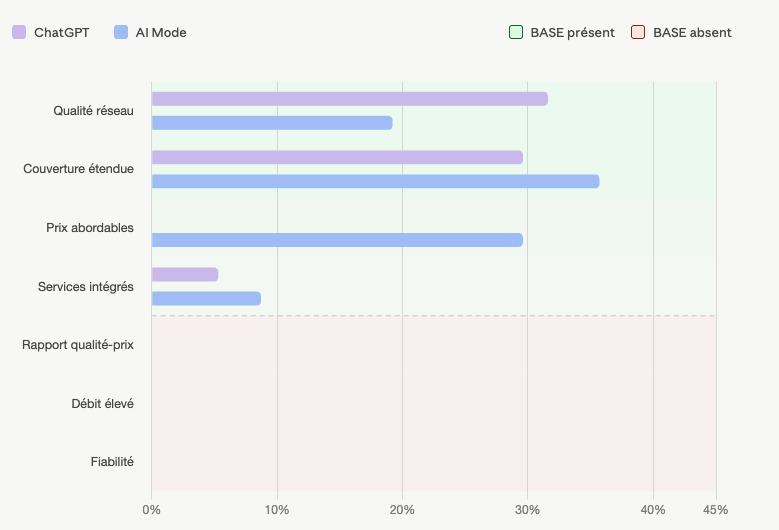
In ChatGPT responses, formulations like "Telenet/BASE" or "Telenet (BASE network)" appear regularly. This convention reflects the sources ChatGPT uses: regulatory bodies group both entities under the same physical network. On network and coverage questions, BASE benefits from Telenet's strength. On every other question, that association disappears, and BASE stands alone, without the editorial content to sustain a presence.

Proximus, Orange, Mobile Vikings and Hey! telecom all publish in French: articles, guides, Test-Achats awards amplified on their own websites. BASE has nothing comparable. The other operators turn their achievements into sources that LLMs cite.
The data from these three sectors point to the same underlying finding, one that some now call "Search Everywhere Optimization": GEO visibility is built wherever your audience is, not only on your own website. Google itself is acknowledging this shift: Search Console now lets you measure the performance of your Instagram, TikTok, X and YouTube accounts in search results. The following directions follow from that logic.
Identify your winnable questions: Rather than competing on "which is the best brand" (a question where established leaders have a structural advantage) each brand can look for the questions where it is legitimately the best answer. The data shows that actors with little national profile can establish themselves on precise queries: an agency specialising in building plots, a provider ranked first on green energy, an operator recognised for customer service. These positions appear more accessible than the fight for the overall podium.
Take care of your Google My Business listing on local queries: On the geolocated questions observed in the corpus, AI Mode drew almost exclusively from GMB listings rather than agency websites. Rating and volume of recent reviews appear to play a decisive role in selection, though other factors may come into play depending on the question.
Publish content that answers one question at a time: Pages that appear in the corpus tend to share one characteristic: they answer the question directly and precisely. A URL that matches the query, content focused on a single clear intent, these appear to favour citation by AI Mode and ChatGPT.

.jpg)



.svg)