EN
How do you optimize your presence on ChatGPT? By giving it HTML content that loads fast, is structured into perfectly self-contained 150-word blocks, accessible through your robots.txt permissions, and backed by strong off-site authority. That’s the essence of GEO. Easy to say — but in practice?
“Search is no longer just ‘search.’”
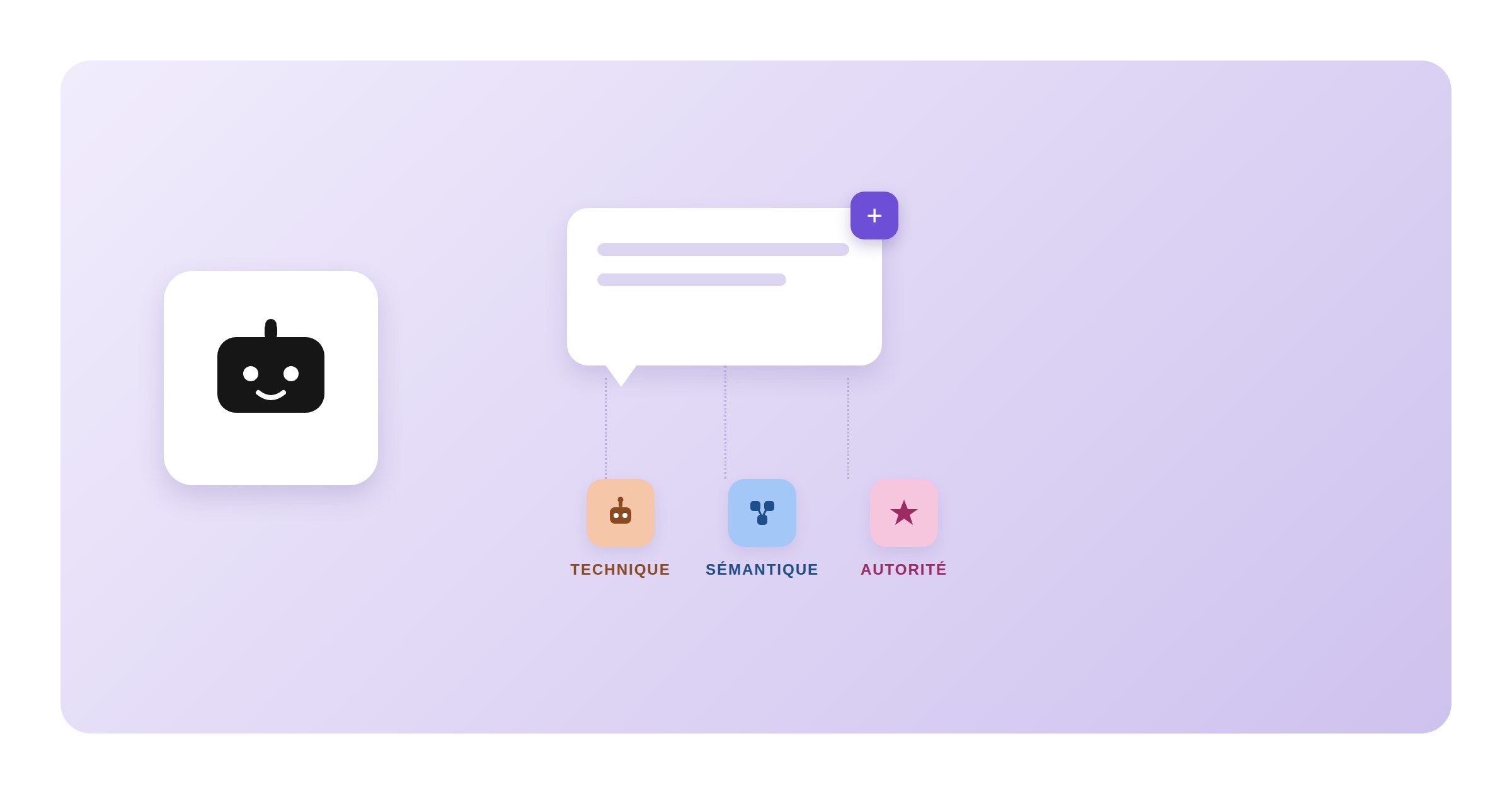
In just a few months, ChatGPT has become a search entry point in its own right for your buyers, B2B and B2C alike. To capture this new kind of traffic, explore our ChatGPT optimization guide and position your brand at the heart of AI answers. Three pillars structure this guide: technical, semantic, and authority. At bottom, these are the same three pillars a mature SEO expert already works on. What changes with generative search — and with ChatGPT in particular — is how you activate them. To get there, you can rely on our 6-step Generative Engine Optimization methodology. ChatGPT doesn’t (yet, and not exclusively) have a proprietary search index as mature as Google’s: long reliant on Bing, it now draws on a mix of third-party data providers and an in-house index still under construction (see the technical section below). This different discoverability mechanic — more unstable, less documented, evolving fast from one model update to the next — reshuffles how you approach each of the three pillars, and that’s precisely what this guide is about. Three pillars, three objectives: Technical — being reachable. Robot permissions, server-side rendering, speed, product feeds: the raw access conditions for your content. Semantic — being understood. Cluster structuring, extractable formats, and recognition of your brand as an entity. Authority — being cited. The trust and reputation signals that make a model retain you — and recommend you.
Four acronyms coexist today — SEO, AIO, AEO, GEO — each with different objectives, levers, and metrics. A confusion common enough to show up even in marketing steering committees.
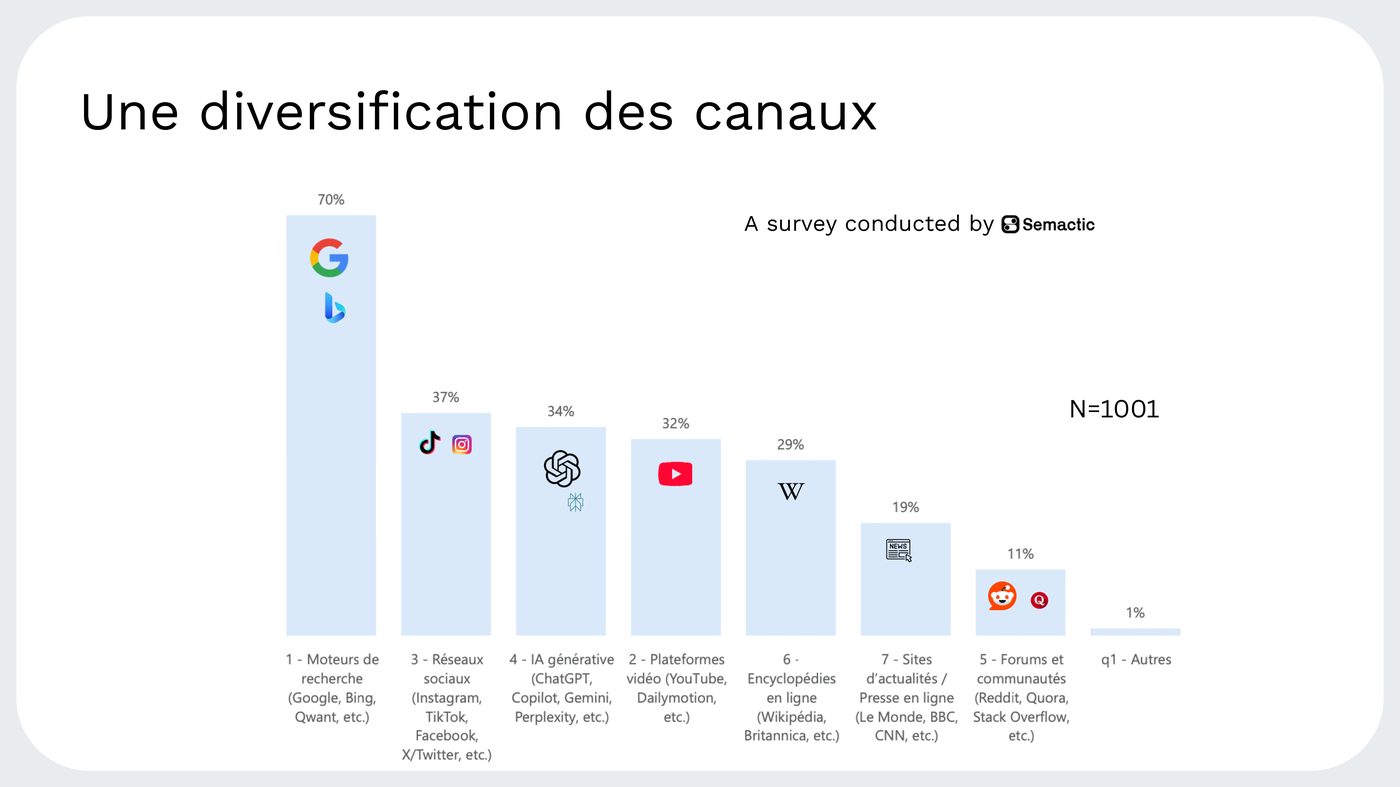
How people search online today — Semactic study, panel n = 1,001, multiple answers possible.
A quick data point before getting into the SEO/LLM SEO/GEO distinction: on this panel, traditional search engines (Google, Bing) remain the most-cited channel (70%) — but generative AI (ChatGPT, Copilot, Gemini, Perplexity) already ranks 3rd (34%), just behind social media (37%) and ahead of video platforms (32%). Combined, social media and generative AI (71%) already outpace traditional search engines on this panel.
Two caveats are needed to read this figure correctly. First, the survey is a year old: in a sector that shifts month to month, it’s a safe bet that generative AI’s share has grown further since. Second — and this is probably the more important point — the line between a “traditional search engine” and an “AI answer” is itself blurring, as Google rolls out AI Overviews more broadly and builds AI Mode natively into classic search: part of what still counts as “Google search” is, in practice, already a generative answer. Treating these channels as perfectly distinct is therefore already, in part, a measurement artifact — which reinforces, rather than weakens, the need to clearly distinguish SEO, LLM SEO, and GEO.
“Classic” SEO optimizes a page so it appears among a search engine’s organic links (Google, Bing): keywords, internal linking, domain authority, position on the results page. The unit of measurement is ranking, and the end goal remains the click.
LLM SEO (sometimes called AI SEO) refers to upstream optimization: making content eligible for training the language models themselves — GPTBot’s territory. A long-term lever, with delayed effects that are hard to measure campaign by campaign, since it acts on the model’s “parametric” memory rather than on any single answer.
Not to be confused with AIO (AI Optimization), a more recent term for using AI tools to produce and industrialize content — ideation, assisted writing, automated quality control — a production approach, not one about visibility as such.
AEO (Answer Engine Optimization) aims for immediate inclusion in a generated answer: structuring content — structured data, question/answer phrasing, natural language processing — so it gets picked up as the answer, in featured snippets, “People Also Ask,” and AI Overviews on both Google and Bing.
The GEO (Generative Engine Optimization) is the broadest evolution of the three: it covers content strategy, data structuring and accessibility, but also reputation signals and the brand’s external credibility — so it’s recognized as a reference, cited, and recommended in AI-generated content, not just present within it. AIO, AEO, and LLM SEO aren’t competing approaches: they’re complementary layers of the same discipline. As a Semactic article on the topic puts it: you no longer need to rank well, you need to be the answer.
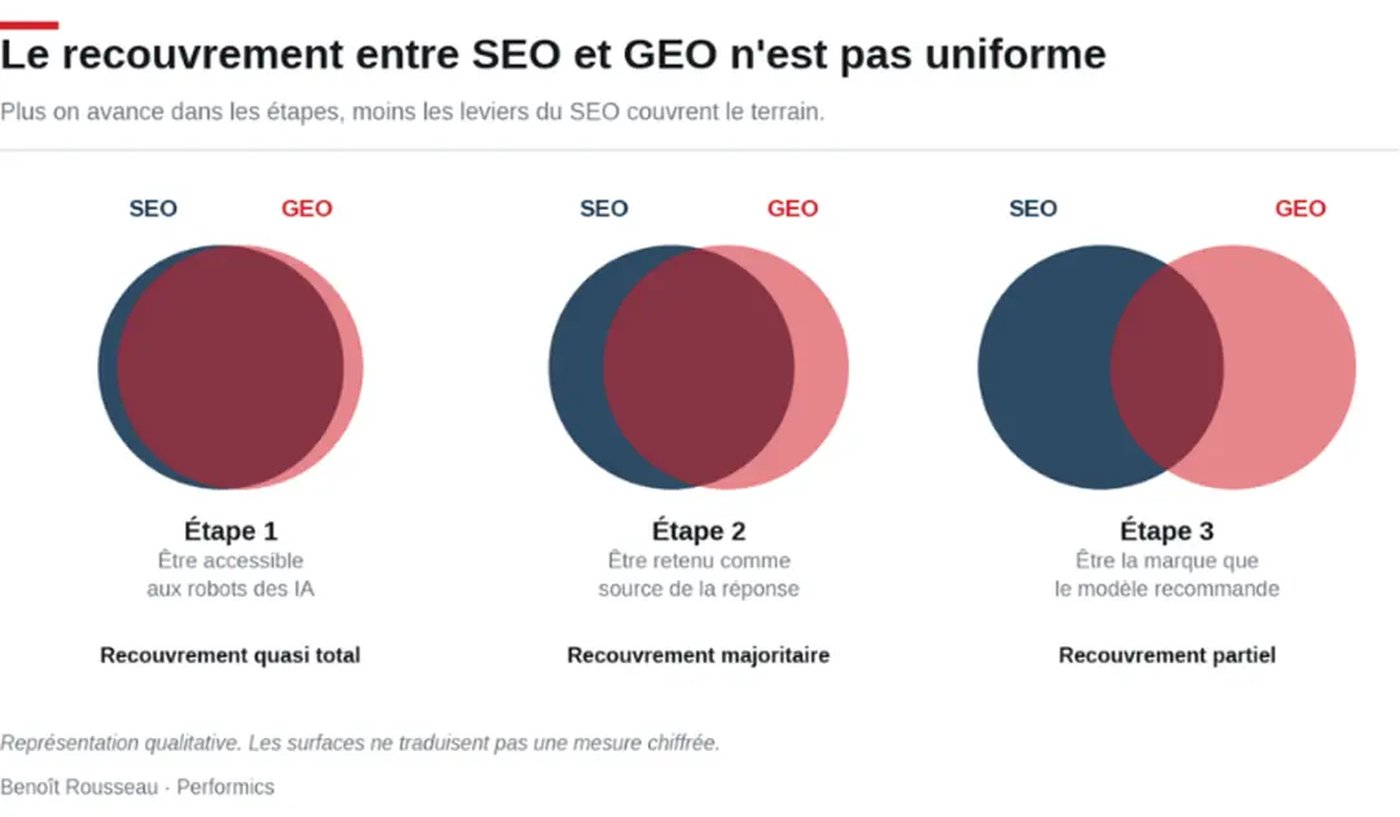
The overlap between SEO and GEO isn’t uniform: it shrinks as you move through the stages. Analysis by Benoît Rousseau · Performics.
This three-stage reading is more useful than a binary SEO/GEO opposition: at stage 1 (being accessible to AI crawlers), SEO’s technical prerequisites — crawlability, speed, architecture — serve GEO almost entirely. At stage 2 (being retained as a source for the answer), the overlap is still mostly there, but semantic structuring makes the difference. At stage 3 (being the brand the model recommends), the overlap becomes partial: ranking in a SERP no longer guarantees anything — only the authority the model perceives counts.
In short, three points:
SEO isn’t going away: it remains the foundation of the three pillars covered in this guide. What changes is how you prioritize them once you move from ranking to citation.
How ChatGPT actually searches, what we currently know about its indexing mechanics, and what to check so you’re not excluded before you’re even evaluated.
The logic of generative search. The cycle breaks down into five steps, whatever the generative engine: a question is asked; the model reformulates it into a list of sub-questions and relevant criteria; a live search is triggered against web results; the retrieved content is synthesized, keeping only the essentials of the original context; an answer is produced, along with sources and links.
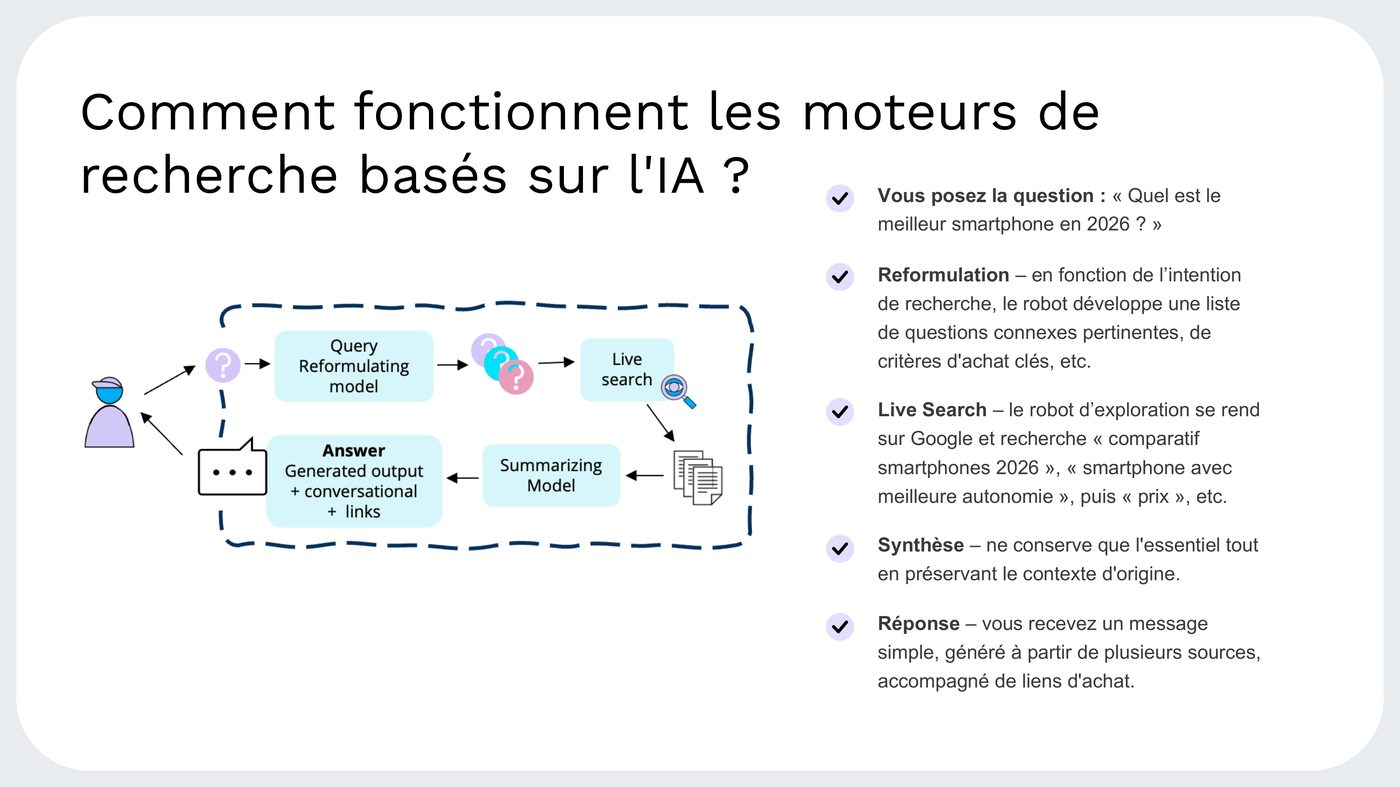
The five-step cycle of a generative search engine.
What fundamentally changes the game compared to classic SEO: the model reacts before a user even clicks on anything. It’s no longer a matter of ranking, but of presence — presence at the right moment in the cycle: reformulation, retrieval, or final synthesis.
This is where ChatGPT diverges most sharply from other generative engines — and where things have changed the most in 2026. For nearly two years, the working assumption commonly accepted in the SEO/GEO industry was simple: ChatGPT has no index of its own, it outsources search to Bing (and, in part, to third-party providers), and it reformulates the user’s question into one or more classic search queries — a mechanism the industry named “query fan-out.”
That assumption now needs to be qualified. Several strands of evidence, documented throughout 2026, converge:
web.run”) orchestrates several waves of queries per answer — from 2-3 for fast models to 10 or more for deep-reasoning models — refining the query at each iteration rather than querying a single engine.The most cautious consensus, as of mid-2026: ChatGPT doesn’t have a proprietary index as mature as Google’s, but it no longer depends on a single third-party engine either. It orchestrates an evolving mix of specialized data providers (general search, shopping, news, local, maps…) and a still-partial internal index — which explains the volatility observed from one model to the next: a version change can shift the number of unique domains cited in answers by more than 20%.
Practical consequence. Two levels of visibility coexist, and content absent from the first never reaches the second: parametric visibility (does your brand exist in the model’s training data — press, Wikipedia, authority sites?) determines whether your domain is even a candidate for a query; dynamic visibility (real-time retrieval) then determines whether the content actually gets extracted. Optimizing only the second without working on the first is like polishing the storefront of a shop nobody knows how to find.
Verification method: open chatgpt.com, turn on your browser’s developer tools (F12), select the Network tab, ask a question that triggers a web search, then look in the API response for the search_model_queries field — it contains the exact query sent to the underlying engine, often much narrower than the original question (“what’s a good family SUV for driving in the city?” becomes “best family SUV city use reviews”). It’s this reformulated query, not the original question, that determines which pages get retrieved.
Four prerequisites govern raw access to your content, before any question of editorial quality even comes up:
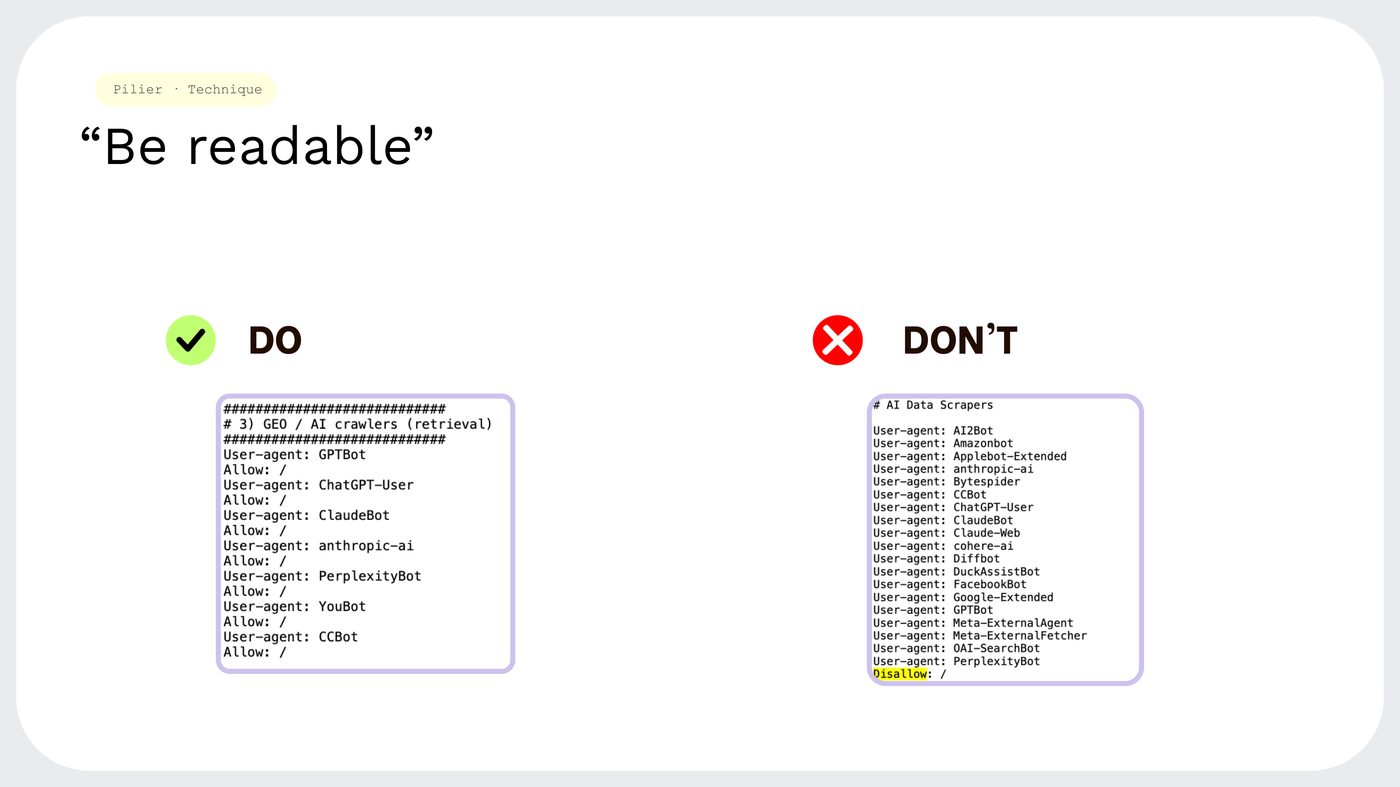
Recommended vs. risky configuration for AI retrieval bots.
# Allow generative search (GEO / retrieval)
User-agent: OAI-SearchBot
Allow: /

User-agent: PerplexityBot
Allow: /

User-agent: ClaudeBot
Allow: /

# Decide based on your model-training policy
User-agent: GPTBot
Allow: /   # or Disallow: / if you refuse to allow training on your content
robots.txt is only a statement of intent: a WAF or CDN (Cloudflare chief among them) can block these user-agents upstream, independent of the file. Have both layers checked, with written confirmation from your agency or infra team — not just a “that should be fine.”
Since 2025, OpenAI has offered merchants a product feed program that feeds directly into ChatGPT’s search and product discovery functions, with — depending on the market and the merchant’s eligibility — an integrated checkout option. Rather than relying on passive indexing of your product pages, you push a structured feed yourself (titles, prices, stock, media) over HTTPS to an endpoint provided by OpenAI, in CSV, TSV, XML, or JSON format. An initial sample validates compliance before going live; once validated, updates can be pushed as often as every 15 minutes.
For a Mid-Market brand that already has a Google Merchant Center or Meta Catalog feed, the integration effort is incremental. The integrated checkout option, where available, does add extra requirements — integration compliant with OpenAI’s agentic commerce protocol, and a verified payment provider. This is a project for e-commerce and IT to run jointly, not a marketing checkbox.
Once your content is reachable, it still needs to be organized so it can be extracted, cited, and unambiguously attributed to your brand.
An LLM doesn’t “read” a page the way a visitor does: it extracts from it, often in fragments, with no guarantee it will go through the whole document. The structure that best serves this fragmented reading is topic-cluster architecture: a pillar page that synthesizes a topic, linked to satellite pages that cover each facet in depth. It’s this structure that lets a model move through your corpus rather than stopping at the first page it finds.
At the scale of a multi-market Mid-Market organization, this structuring can’t be handled page by page: it requires a content template applied systematically across the CMS, a coverage audit per cluster, and clear governance over content freshness — a visible, and genuine, last-updated date.
A generative model favors self-contained content blocks: a unit of meaning complete in itself, one that doesn’t depend on the previous paragraph to be understood.
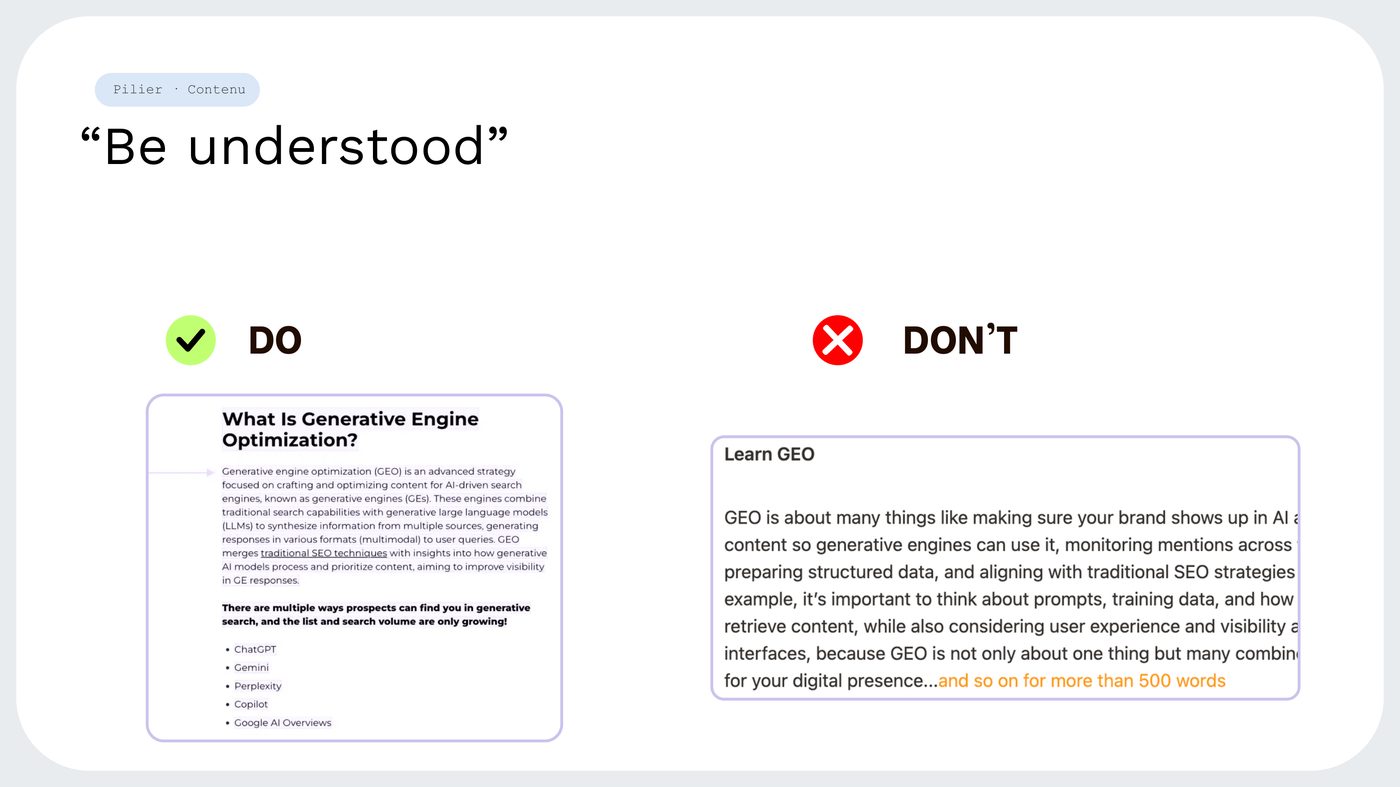
A structured, self-contained block (left) versus a dense 500-word wall of text (right).
A generative model doesn’t work with keywords but with entities: disambiguated identities tied to Google’s Knowledge Graph through a unique identifier (KGMID). A fuzzy entity — a name shared with someone else, attributes that are inconsistent from one site to another — simply cuts off visibility, or worse, redirects the value to the wrong identity. The documented case of Danny Goodwin, whose professional identity stayed merged for ten years with that of a Hall of Fame baseball player in the Knowledge Graph, illustrates the real cost of a poorly established entity: the Knowledge Panel disappearing outright.
Three conditions let an AI engine correctly recognize an entity — a brand or an executive:
In practice: build an “Entity Home” — a reference page with explicit schema.org Person or Organization markup, opening with an unambiguous summary (“[Name] is [Title] at [Organization]”) — then create a corroboration loop (social profiles and professional directories with sameAs markup, consistent name/address/phone, press mentions) pointing back to that page with identical attributes. Expect around 4 months for a stable entity identifier to be assigned, and up to 12 months for fully stabilized recognition.
sameAs)The pillar most often underestimated — and the most decisive one, as generative engines concentrate their citations on a smaller number of sources.
The technical pillar makes content reachable, the semantic pillar makes it understandable — but neither guarantees that a generative model will choose to cite it over an equally well-structured competitor. That’s the role of authority: the external trust signals that make a model retain one source over another.
The reference research on this topic — the foundational “Generative Engine Optimization” study from Princeton and IIT Delhi (Aggarwal et al.) — experimentally measured the effect of different levers on a source’s visibility in a generated answer: adding verifiable citations and statistics remains, in their measurements, one of the most effective individual levers, ahead of simply adding keywords. In other words: content that cites its sources and backs its claims with numbers is mechanically better retained than unsourced, assertive content — the opposite of many marketing writing habits.
This finding lines up with a trend observed in 2026 on ChatGPT specifically: with each model update, the average number of unique domains cited per answer tends to shrink, in favor of a smaller set of sources judged most reliable — a phenomenon some industry practitioners have nicknamed the “Bigfoot effect” (everyone talks about it, few concrete sources actually document it). A direct consequence: being a correct source is no longer enough; you need to be a source whose authority is already established elsewhere before the query even happens.
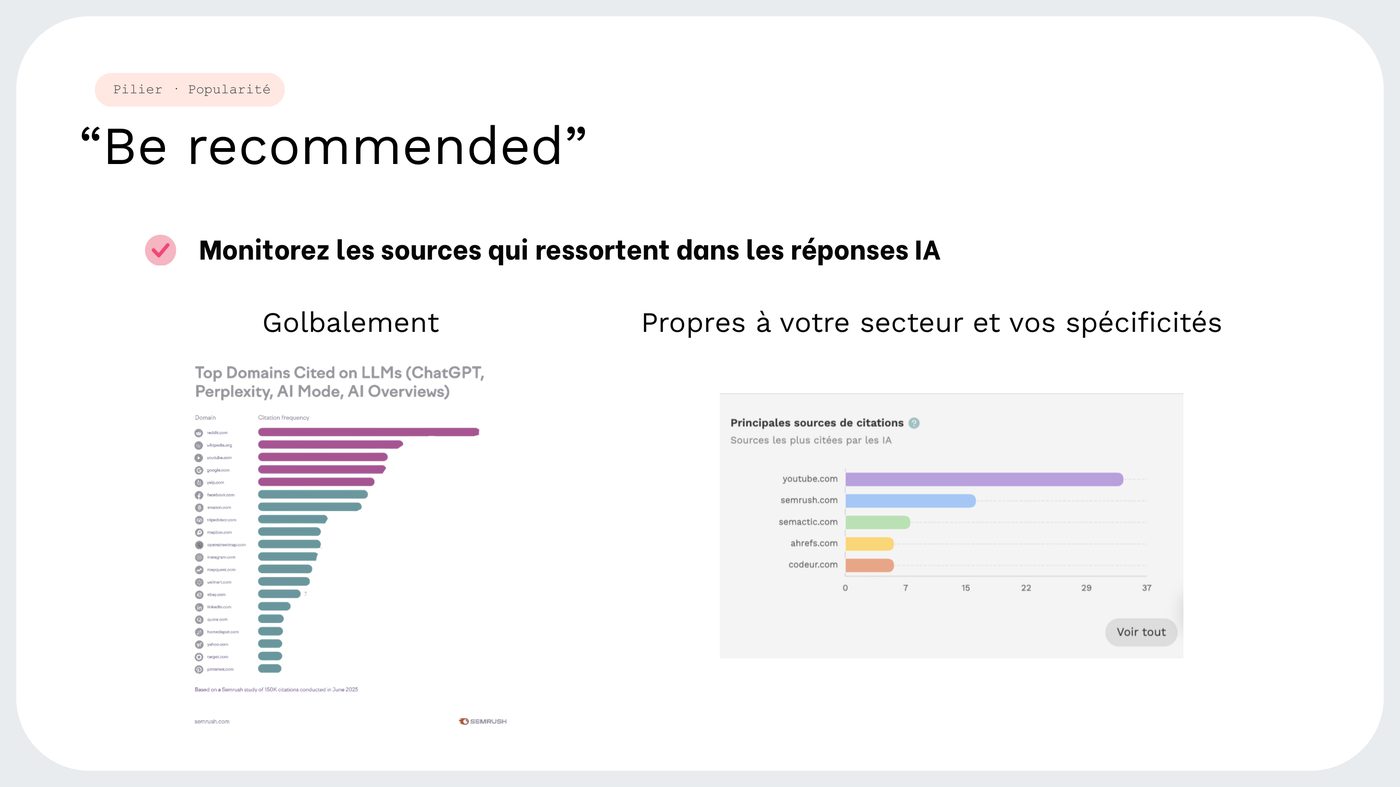
Most-cited domains in AI answers — Semrush study, 150,000 citations, June 2025.
This study confirms that the most-cited domains mix global platforms (Reddit, Wikipedia, YouTube) with sector-specific authority sites — a spot a Mid-Market brand can claim within its own industry, without having to compete with the giants of generic rankings. This is all the more strategic given that 2027 should, based on investment signals observed on OpenAI’s side (proprietary indexing, specialized verticals), further tighten the selectivity of retained sources rather than loosen it.
A roadmap that revisits, in order, the three pillars covered in this guide — and classic SEO’s place in this equation.
search_model_queries), what ChatGPT actually retrieves and displays from your pages.Steps 4, 5, and 6 run in a short loop, repeated cluster by cluster, rather than as a single sequence: this is ongoing work, not a project with an end date.
SEO isn’t disappearing: on the Semactic panel, traditional search engines remain the most-used channel (70%), far ahead of generative AI (34%). The foundations of good SEO — domain authority, internal linking, freshness, crawlability — are exactly what feeds the three pillars covered in this guide. Facing competitors with bigger budgets or more brand recognition, two levers remain within reach of a Mid-Market organization: sector or geographic focus (going deep on a specific segment rather than targeting a generic market), and clear differentiation, repeated consistently across content rather than diluted into a consensus-style message like “we offer quality service to all our customers.”
Case in point: Daikin, the HVAC market leader in Belgium, entrusted Semactic with restructuring its technical content for generative search — a topic-cluster approach, self-contained content blocks (≤150 words), multimodal content, and continuous updates. Result: increased citation as a source in ChatGPT and Perplexity on the sector’s key queries, without having to sacrifice the brand’s traditional SEO to get there. See the full case study →
.avif)



.svg)